The Jiufen + Shifen day, start to finish
Two very different Taiwans, an hour apart
Jiufen and Shifen aren't the same kind of place, which is exactly why they're usually paired. Jiufen is a gold-mining town clinging to a mountainside above the coast, built on Qing-dynasty gold deposits and peaked under Japanese colonial rule; when the mines closed in 1971 it emptied out almost completely, only to be rediscovered after Hou Hsiao-hsien's 1989 film A City of Sadness — shot on location there — won the Golden Lion at Venice and sent Taiwanese tourists back up the hill. Shifen is a different story: a strip of houses and teahouses squeezed onto a narrow ledge along the Pingxi branch railway, where, in New Taipei City's account, early 19th-century Fujian settlers harassed by bandits used sky lanterns to signal that they were safe.
What a single day actually covers
Door to door from central Taipei, the guided tour is listed at about seven hours, and the booking page calls that an estimate that traffic and weather can change. That is enough time to walk both old streets, release a lantern and see the waterfall, without the trip turning into a transit day. On your own, Shifen is on the Pingxi branch line and Jiufen is reached by bus, because it has no station of its own.
Why the running order matters
The tour we feature below visits Shifen first, in daylight, and saves Jiufen for last. There's a practical reason: the waterfall and the lantern release both photograph and simply feel better in daylight or at golden hour, while Jiufen's whole appeal is the lantern glow against the dark, so arriving as dusk falls is when the town looks like the photos. Doing it the other way round — Jiufen by day, Shifen at night — leaves you fighting crowds in flat afternoon light at the one place and standing in the dark at a working railway stop for the other.
The day at a glance
- Typical lengthAround 7 hours door to door, including travel time from central Taipei
- Usual departureStarting times depend on the date and option, and the booking calendar shows them; Shifen comes first and Jiufen is seen as the sky darkens
- What's coveredA licensed guide, transport and insurance, with time at the waterfall, Shifen Old Street and Jiufen. Food, drinks and your lantern are not included
- When it runsCheck the booking calendar for your date; shared and private options are offered, and the booking page notes that traffic or weather can affect timings
After dark in the mountains
Jiufen Old Street after dark
The stairway everyone photographs
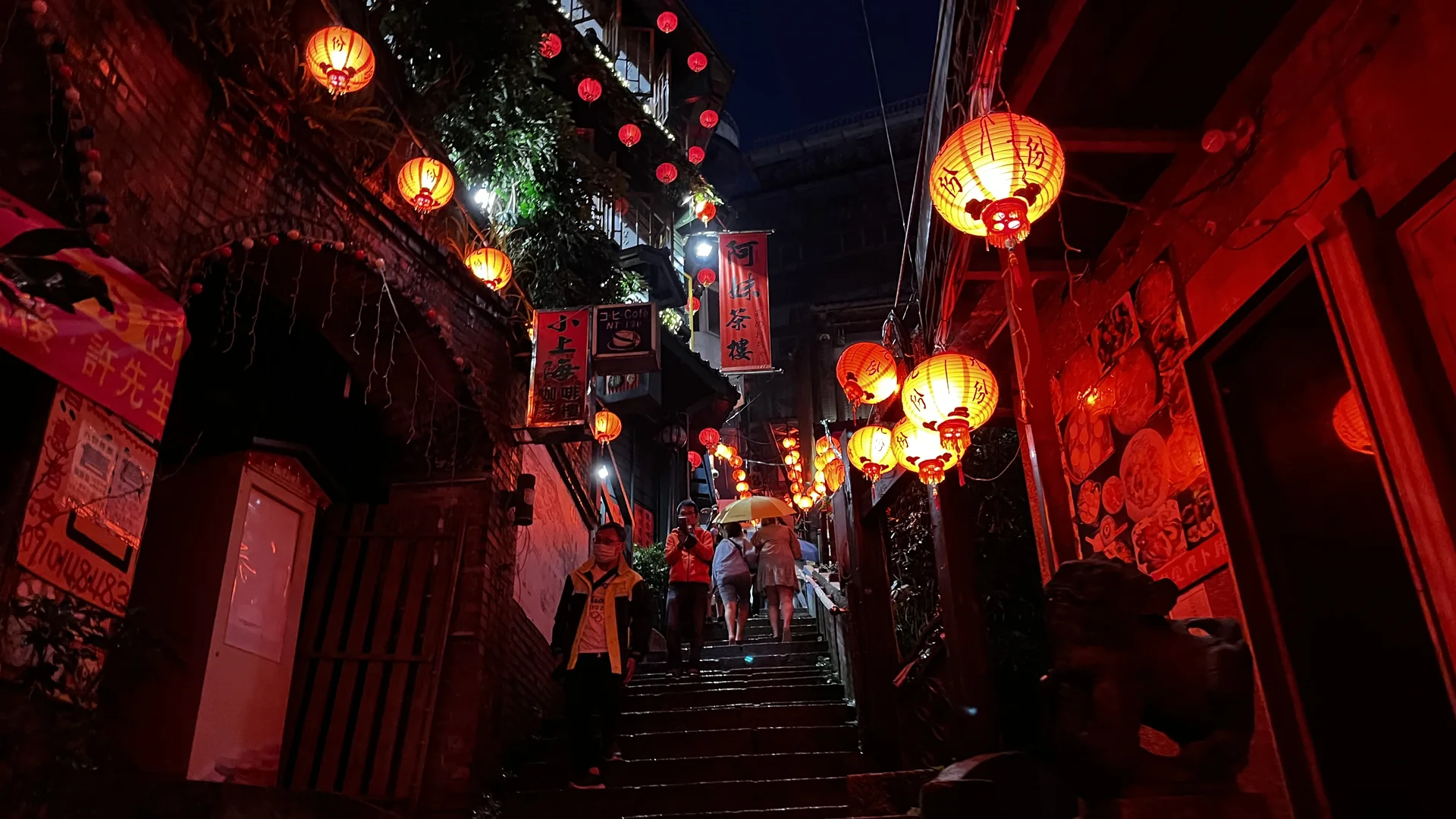
Shuqi Road — the steep, narrow stone stairway lined with red lanterns and stacked teahouses — is the image most people have of Jiufen before they've ever been, and in person it's narrower and steeper than it looks in photos. It is a stepped lane of teahouses and shopfronts, with red lanterns hung along it. Expect to queue for the best photo spots on the stairway itself on a Saturday night — it's a single-file street on a hillside, and everyone visiting wants the same shot.
The Spirited Away question
It comes up on almost every visit: does Jiufen's lantern-lit, multi-level old town look like the bathhouse world of Hayao Miyazaki's Spirited Away? Visually, yes, close enough that the comparison follows the town everywhere — but Hayao Miyazaki has denied that Jiufen was the model for the film. What Jiufen and the film share is a real historical type: dense, vertical Taiwanese mining-town architecture, the kind of place that looks partly imagined even when it isn't. Go for the atmosphere on its own terms and the resemblance is a bonus, not the reason to visit.
The teahouses, and what to actually expect
Jiufen's teahouses are a sit-down, slow-down stop rather than a quick coffee. The Tourism Administration lists them, with the view over the sea off Keelung, among the reasons to visit, and a Taiwan feature credits one teahouse, in a century-old former residence on Jishan Street, with sparking the town's second golden age. A window table is never guaranteed, so treat the teahouse as a pleasant extra rather than a plan.
Down in the Pingxi valley
Shifen: sky lanterns & the waterfall
Writing a wish, then letting it go
At the stalls along Shifen Old Street you buy a paper lantern, write your wishes on it with a brush, and release it by hand. New Taipei City's tourism site describes the lanterns as rice paper, written on with a Chinese writing brush, with paper money placed inside as the fuel that lifts them. They rise over the railway that runs through the middle of the street, so keep clear of the tracks when a train is due and cross only where the signs say you can.
Where the tradition actually comes from
The sky lantern has an older, practical story behind it. New Taipei City's tourism site says that in the early 19th century Fujian immigrants reclaiming Pingxi were often harassed by bandits, and sky lanterns were used to signal that they were safe. Other origin stories exist, including the Three Kingdoms tale of Zhuge Kongming, which is why they are also called Kongming lanterns. Pingxi revived its lantern culture in the 1990s, and the city has held the Pingxi Sky Lantern Festival since 1999, on Lantern Festival day and the weekend before it.
The waterfall itself
Shifen Waterfall is about 40 metres wide and 20 metres high, a broad curtain of water rather than a narrow drop, and the broadest waterfall in Taiwan. New Taipei City's tourism site calls it Taiwan's Niagara Falls because its rock slopes against the flow, a comparison about shape, not scale. Mist often forms rainbows on sunny days, which gives the pool its nickname, Rainbow Pool. It sits in a municipal park with several viewing platforms, an easy add-on to the lantern release.
More ways to see Jiufen & Shifen
Find a Jiufen & Shifen day tour for your dates
No matter which one you pick, it's GetYourGuide running the checkout itself — real-time availability for your travel date, priced in your own currency, all before you commit to anything.
Getting there
How to do it: guided tour vs train-and-bus
Both sites are reachable without a tour — the question is whether the time and hassle saved is worth the fixed schedule. Here's what each one actually involves.
Simplest, fixed schedule
A guided day tour
A licensed guide meets you at the start point (the booking page lists MRT Taipei Main Station, exit M3, for the standard option), takes you to Shifen and Jiufen by the itinerary's transport, and builds the day so Jiufen comes as the sky darkens. Transport and insurance are included; food, drinks and your lantern are not. You give up choosing your own pace and order in exchange for not having to plan train connections or find your own way back after dark.
Cheaper, more flexible, more homework
Train and bus, self-guided
From Taipei, take a Taiwan Railway train to Ruifang, then either a Pingxi branch-line train to Shifen, or a bus to Jiufen, which has no station of its own (the nearest are Houtong, Ruifang and Badouzi). Getting between Jiufen and Shifen means going back through Ruifang. The Pingxi line is a single-track branch, so the timetable shapes your day. It lets you linger, but only if you are comfortable reading a Taiwan Railway timetable and don't mind connections that may not line up.
Timing it right
Best time of day & year to go
What time of day, and why it's not just about crowds
Arrive in Shifen while there's still good light for the lantern release and the waterfall, then time Jiufen for the window right at dusk — not full darkness, when the lanterns are lit but there's still enough ambient light to see the layout of the stairways and the sea beyond them. That's a narrow window, which is why this tour is built to reach Jiufen as the sky is getting dark.
Weekday versus weekend
Shuqi Road on a Saturday evening is genuinely crowded — a slow, shuffling queue rather than a stroll — while a weekday visit, even at the same dusk hour, is a noticeably different experience with room to actually stop and look. Shifen's old street is narrower still and shares its width with a working railway, so weekday visits are the easier choice there too if your schedule allows it.
Season and weather
The Pingxi Sky Lantern Festival is held on Lantern Festival day, with a second release on the weekend before it, so its dates follow the lunar calendar; check New Taipei City's tourism site for the year. Festival days are far busier than an ordinary visit. Pingxi also has many rainy days, so bring rain gear, and expect Jiufen's stone steps to be damp underfoot. The mist suits Jiufen's atmosphere more than it hurts it.
GEO/FAQ
Jiufen & Shifen questions
Can I visit Jiufen and Shifen in one day without a tour?
Yes. Take a Taiwan Railway train from Taipei to Ruifang, then either a Pingxi branch-line train to Shifen or a bus to Jiufen, which has no station of its own. There's no rail line between Jiufen and Shifen themselves, so you'll route back through Ruifang. It depends on train timetables that don't always line up neatly, which is where a guided tour helps.
Why do tours visit Shifen before Jiufen, not the other way round?
Because each site suits a different light. The waterfall and the sky lantern release both look and photograph better in daylight or at golden hour, while Jiufen's lantern-lit stairways are the whole point of visiting after dark. Doing Shifen first and Jiufen last means you arrive in Jiufen right as dusk falls, which is when the town looks like its photos.
Is Jiufen actually the inspiration for Spirited Away?
Not according to Hayao Miyazaki, who has denied that Jiufen was the model for the film. What the two share is a real architectural type: dense, vertical Taiwanese mining-town buildings stacked up a hillside, which is genuinely close enough in feel that the comparison follows the town everywhere. Worth visiting for what it actually is, with the resemblance as a bonus rather than the main draw.
What does releasing a sky lantern in Shifen actually involve?
You buy a paper lantern from one of the stalls on Shifen Old Street and write wishes on it with a brush. New Taipei City's tourism site says paper money is placed inside as the fuel that lifts it. It rises over the railway that runs through the middle of the street, so keep clear of the tracks when a train is due and cross only where the signs say you can.
Where does the sky lantern tradition actually come from?
It has a practical story behind it, though accounts differ. New Taipei City's tourism site says that in the early 19th century Fujian immigrants reclaiming Pingxi were often harassed by bandits, and sky lanterns were used to signal that they were safe. The best-known legend names Zhuge Kongming. Pingxi revived its lantern culture in the 1990s, and the city has held a Sky Lantern Festival since 1999.
How big is Shifen Waterfall, really?
About 40 metres wide and 20 metres high — a broad curtain-shaped drop rather than a narrow one, and the broadest waterfall in Taiwan. New Taipei City's tourism site calls it Taiwan's Niagara Falls because of the way its rock slopes against the flow. That's a comparison about shape, not size; it is only a fraction of Niagara's scale. It sits in a municipal park with several viewing platforms.
Is Jiufen crowded, and does it matter which day I go?
Yes, noticeably — Shuqi Road on a Saturday evening is a slow, shuffling queue rather than a stroll. A weekday visit at the same dusk hour is a genuinely different, calmer experience with room to actually look around. Shifen's old street, being narrower still and shared with a working railway, benefits from a weekday visit too if your schedule allows it.
What's the best time of year, and is there a specific festival?
The Pingxi Sky Lantern Festival is held on Lantern Festival day, with a second release on the weekend before it, so its dates follow the lunar calendar. It is the biggest version of the ritual, but festival days are far busier than an ordinary visit. Check New Taipei City's tourism site for the year's dates. Pingxi also has many rainy days, so bring rain gear whenever you go.
How long does the whole day trip take?
The guided tour is listed at about seven hours, and the booking page calls that an estimate that traffic and weather can change. That is enough time to walk both old streets, release a lantern and see the waterfall without the day becoming mostly transit. The booking calendar shows your start time.
How does checkout work, and will the price change at the last step?
Checkout runs through GetYourGuide: it converts everything to your own currency and locks in the total, plus the cancellation terms for your chosen date, before you hand over any payment details — nothing gets added afterward. We put this itinerary together as an independent guide to Jiufen and Shifen; neither the tour company nor the railway processes your booking, GetYourGuide's own checkout does.