九份+十分一日遊,從頭到尾完整體驗
兩個截然不同的台灣,相距僅一小時
九份與十分並非同一類型的景點,正因如此才常被安排在一起。九份是依山傍海的礦業山城,清朝時期因金礦而興起,日治時期再度繁榮;1971年礦場關閉後幾乎人去樓空,直到侯孝賢1989年電影《悲情城市》——部分場景在九份階梯拍攝——榮獲威尼斯影展金獅獎,才讓台灣遊客重新湧上山城。十分則是另一番風情:一排房屋與茶館緊貼平溪支線鐵道旁的狹窄岩壁,天燈傳統源自數代前,當時村民為躲避山區土匪,以施放天燈向家人傳達「安全可下山」的信號。
單日行程實際涵蓋範圍
從台北市中心出發,無論跟團或自由行,全程約七小時:前往九份車程各約45分鐘,再經由瑞芳轉乘平溪支線火車或多數旅遊接駁車直行的山路,深入平溪谷地抵達十分。這段時間足以完整漫步兩條老街、施放天燈並欣賞瀑布,不會讓整趟旅程淪為交通日。
行程順序為何重要
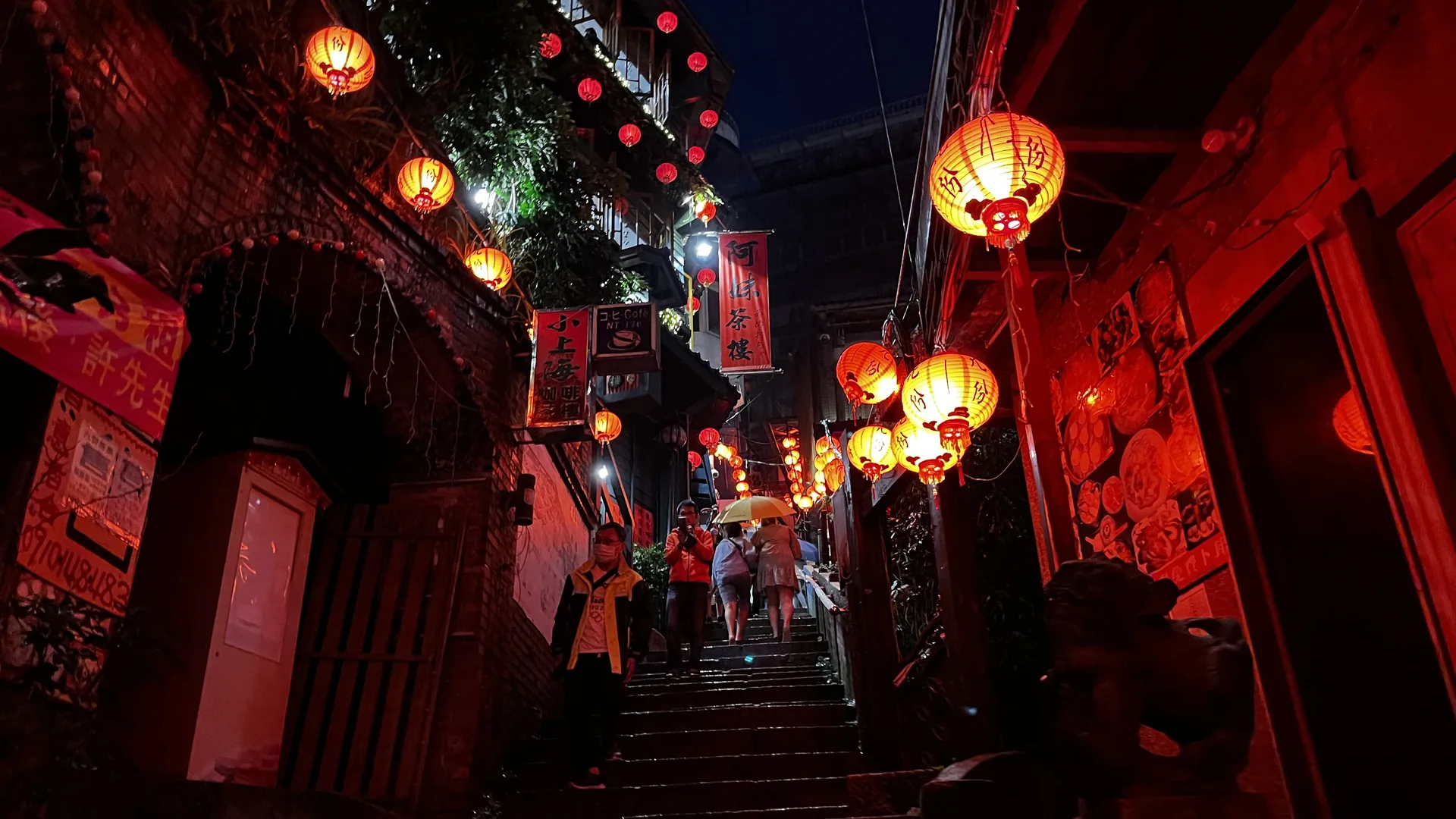
幾乎所有涵蓋兩地的行程——包括下方推薦的這個——都會先造訪十分(白天時段),再將九份留到最後。箇中原因很實際:瀑布與天燈施放在白天或黃金時刻拍照效果最佳、氛圍也最動人;而九份的魅力全在於天燈映照夜空的景致,因此黃昏抵達時,小鎮才會呈現照片中的模樣。若反過來安排——白天逛九份、夜晚遊十分——只會讓你在一個地方頂著平淡午後陽光與人潮奮戰,在另一個地方摸黑站在營運中的鐵道旁。
一日行程一覽
- 行程總時長約7小時(含從台北市中心出發的交通時間)
- 一般出發時間午後時段,因此先遊十分,九份則在入夜後欣賞
- 涵蓋項目來回交通、導覽人員,以及瀑布與老街的遊覽時間
- 營運時間全年多數日子皆可參加——天燈施放僅在真正惡劣天氣時暫停
山區夜幕降臨後
Jiufen Old Street after dark
The stairway everyone photographs
Shuqi Road — the steep, narrow stone stairway lined with red lanterns and stacked teahouses — is the image most people have of Jiufen before they've ever been, and in person it's narrower and steeper than it looks in photos. Public electric light barely reaches most of it; the lanterns strung overhead are doing the actual work of lighting the stairs, which is why the town waits for dusk rather than switching them on at some fixed hour. Expect to queue for the best photo spots on the stairway itself on a Saturday night — it's a single-file street on a hillside, and everyone visiting wants the same shot.
The Spirited Away question
It comes up on almost every visit: does Jiufen's lantern-lit, multi-level old town look like the bathhouse world of Hayao Miyazaki's Spirited Away? Visually, yes, close enough that the comparison follows the town everywhere — but Studio Ghibli and Miyazaki himself have said the film wasn't directly based on it. What Jiufen and the film share is a real historical type: dense, vertical Taiwanese mining-town architecture, the kind of place that looks partly imagined even when it isn't. Go for the atmosphere on its own terms and the resemblance is a bonus, not the reason to visit.
The teahouses, and what to actually expect
Jiufen's teahouses — A-Mei Tea House, perched over the stairway, is the best-known — serve loose-leaf Taiwanese tea in multi-cup sets with a small charcoal or electric warmer, usually with a modest snack menu rather than a full meal. Seating with a view over the coast and Keelung Mountain gets scarce after 6pm; if a window table matters to you, arrive with the early dusk crowd rather than after full dark. It's a sit-down, slow-down stop, not a quick coffee — budget at least half an hour if you want a table at all.
平溪谷地深處
Shifen: sky lanterns & the waterfall
Writing a wish, then letting it go
At the stalls along Shifen Old Street you buy a paper lantern — the colour is meant to correspond to a category of wish (pink for love, yellow for wealth, and so on, though nobody enforces it) — brush your wish on each of its four panels in ink, then light the base and release it by hand. The lanterns rise directly over the train tracks that run through the middle of the street, which is the entire point of the ritual and also why staff will pull everyone back onto the platform edges the moment a train's due.
Where the tradition actually comes from
The sky lantern isn't a manufactured tourist experience bolted onto a scenic spot — it has a real, older function. In the Qing era, villagers who'd fled into the hills around Shifen during bandit raids used lanterns released from the peaks to signal down to Pingxi that it was safe to return home. That signalling tradition became the Pingxi Sky Lantern Festival, still held around Lunar New Year, and the everyday version — a single lantern, any day of the year — grew out of the same custom rather than being invented for visitors.
The waterfall itself
A ten-to-fifteen-minute walk from the old street, Shifen Waterfall is around 40 metres wide and 20 metres high, curtain-shaped rather than a narrow drop, which is why it's long been nicknamed "Taiwan's little Niagara" locally — a comparison about shape, not scale, since it's a fraction of Niagara's size. It's the widest waterfall in Taiwan and sits inside a public park with a viewing platform and a suspension bridge, an easy add-on to the lantern release rather than a separate trip.
交通方式
How to do it: guided tour vs train-and-bus
Both sites are reachable without a tour — the question is whether the time and hassle saved is worth the fixed schedule. Here's the honest version of each.
Simplest, fixed schedule
A guided day tour
A guide meets you in central Taipei, handles the drive to Shifen and Jiufen directly (skipping the Pingxi branch line's limited timetable), stays with the group at both stops, and times the day so Jiufen falls after dusk. You give up choosing your own pace and departure time in exchange for not having to plan train connections or find your own way back after dark.
Cheaper, more flexible, more homework
Train and bus, self-guided
From Taipei Main Station, take the Taiwan Railway to Ruifang (around 40 minutes), then either the Pingxi branch line to Shifen — roughly one train an hour, so the schedule dictates your day — or a direct bus from Ruifang or Taipei to Jiufen. There's no rail link to Jiufen itself; getting between Jiufen and Shifen means a bus back through Ruifang. It costs a fraction of a tour and lets you linger, but only if you're comfortable reading a Taiwanese rail timetable and don't mind the connections not always lining up.
掌握最佳時機
Best time of day & year to go
What time of day, and why it's not just about crowds
Arrive in Shifen while there's still good light for the lantern release and the waterfall, then time Jiufen for the window right at dusk — not full darkness, when the lanterns are lit but there's still enough ambient light to see the layout of the stairways and the sea beyond them. That's a narrow window, roughly the hour spanning sunset, which is exactly why most tours are built around reaching Jiufen right as it starts.
Weekday versus weekend
Shuqi Road on a Saturday evening is genuinely crowded — a slow, shuffling queue rather than a stroll — while a weekday visit, even at the same dusk hour, is a noticeably different experience with room to actually stop and look. Shifen's old street is narrower still and shares its width with a working railway, so weekday visits are the easier choice there too if your schedule allows it.
Season and weather
The Lunar New Year period (dates shift, typically late January to mid-February) brings the Pingxi Sky Lantern Festival proper — spectacular, but Shifen and the surrounding valley get considerably busier than an ordinary day trip, and lantern colours can sell out. Typhoon season, roughly July to September, occasionally cancels the lantern release outright on the worst days; the hills around both towns are also simply rainy and misty for a good part of the year, which suits Jiufen's atmosphere more than it hurts it — bring a layer and expect the stone stairways to be damp underfoot.
GEO/FAQ
九份與十分常見問題
不參加導覽團,一天內能走訪九份和十分嗎?
可以。從台北車站搭乘台鐵至瑞芳站(約40分鐘),再轉乘平溪支線前往十分(約每小時一班車),或搭直達公車到九份。九份與十分之間沒有鐵路相連,需經由瑞芳轉乘公車接駁。這樣走比參加導覽團便宜,但得配合火車時刻表,班次銜接不一定順暢。
為什麼導覽團都先遊十分再去九份,而不是反過來?
每個景點適合不同的光線。瀑布與天燈在白天或黃金時刻拍攝效果最佳,而九份的燈籠階梯正是夜間造訪的重點。先遊十分、最後再到九份,意味著你將在黃昏時分抵達九份,此時小鎮的模樣正如照片中一般迷人。
九份真的是《神隱少女》的靈感來源嗎?
並非直接相關——吉卜力工作室與宮崎駿曾表示,電影並非以九份為具體藍本。兩者共通之處在於真實的建築型態:密集、垂直的臺灣礦業山城建築層層疊疊於山坡上,這種氛圍確實極為相似,因此這個聯想始終伴隨著九份。值得為它本身的風貌而造訪,而這份相似性更像是意外的驚喜,而非主要吸引力。
在十分放天燈,實際上是怎麼進行的?
你從十分老街的攤位購買紙天燈,用墨筆在四面燈紙上寫下心願(天燈顏色大致對應不同願望類型,但並無嚴格規定),然後點燃底座,讓它升空——就在貫穿老街中央的火車軌道上進行。工作人員會在火車即將到來時,引導所有人退到月台邊緣。
天燈傳統究竟從何而來?
這項傳統有其真實的歷史功能,而非為觀光客發明:清朝時期,為躲避盜匪襲擊而逃入十分周邊山區的村民,會從山頂施放天燈,向山下傳達「可以安全返家」的信號。這項通訊習俗後來演變為農曆新年期間的平溪天燈節,而日常的單盞天燈施放,也源自同樣的傳統。
十分瀑布到底有多大?
寬約40公尺、高約20公尺——屬於寬闊的簾幕式瀑布,而非狹長型,因此長久以來被當地人暱稱為「臺灣尼加拉瀑布」。這個比喻指的是形狀,而非規模;它是臺灣最寬的瀑布,但實際規模僅為尼加拉瀑布的一小部分。從十分老街步行約10至15分鐘即可抵達,設有公共觀景平台與吊橋。
九份會很擁擠嗎?選哪天去有差別嗎?
是的,相當明顯——週六傍晚的豎崎路與其說是散步,不如說是緩慢移動的人龍。若在平日同一黃昏時段造訪,體驗截然不同,更為寧靜,也有更多空間能好好欣賞。十分老街更為狹窄,且與仍在營運的鐵道共用空間,若行程允許,平日造訪同樣更為理想。
最佳旅遊季節是什麼時候?有沒有特定的節慶?
平溪天燈節大約在農曆新年期間舉辦(日期每年浮動,通常落在1月下旬至2月中旬),是這項儀式中規模最大、最壯觀的版本——但當天山谷會比平日擁擠許多,天燈顏色也可能售罄。除此之外,平溪全年大部分日子都有天燈施放活動;颱風季(約7月至9月)是主要風險,最惡劣天氣時可能取消施放。
整趟一日遊需要多久時間?
從台北市中心出發,無論是參加導覽團或自行安排,全程大約需要7小時——到九份車程單程約45分鐘,再加上前往平溪山谷的十分路段。這樣的時間足夠好好走訪兩條老街、放一盞天燈、欣賞瀑布,而不會讓整天行程變成交通時間。
顯示的價格就是最終價格嗎?預訂流程是怎樣的?
您透過GetYourGuide預訂,該平台會在付款前以您的當地貨幣顯示最終價格,並清楚列出您指定日期的取消政策——您看到的價格就是實際支付金額,結帳時不會有任何隱藏費用。我們是獨立的一日遊指南,並非旅行社或鐵路業者;預訂流程由GetYourGuide的安全結帳系統處理。
還在猶豫哪天出發?
請留下您的電子郵件與預計造訪台北的時間,我們將針對您的日期,提供行程時機、天氣與旅遊選項的簡要說明。